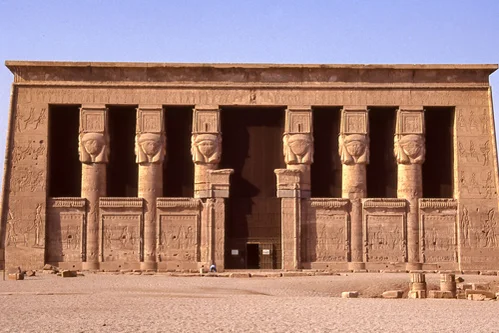
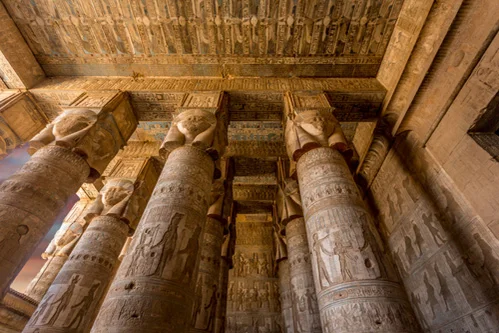
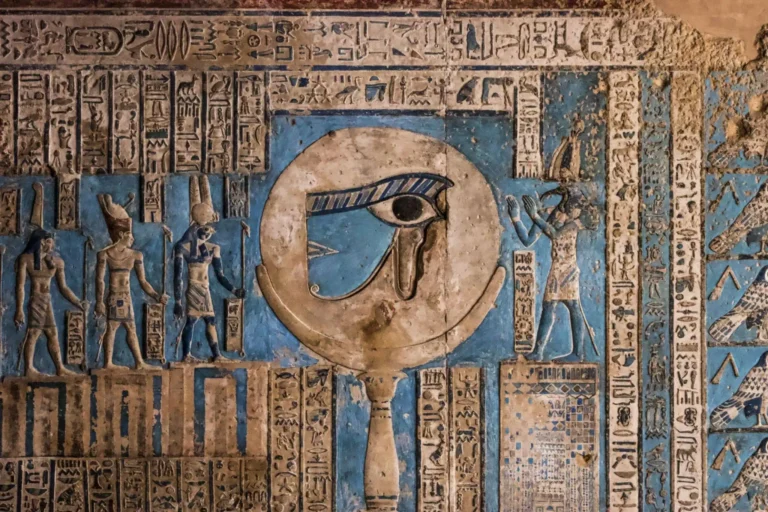
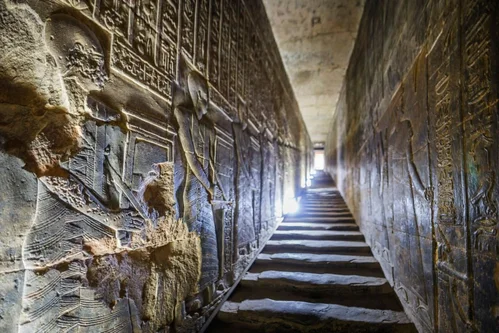
Arriving in Qena, a stunning city, then traveling to the west bank of the Nile to see the Dendera temple.
The majority of the Temple of Hathor was built in the Late Ptolemaic era, more precisely under Ptolemy XII and Cleopatra VII. During the Roman era, several additions were made. With the exception of the front of the hypostyle hall, which was built by Emperor Tiberius, according to an inscription above the entrance, the design of this temple has been found to be consistent with other classical Egyptian temples, despite being constructed by a dynasty of rulers who were not native Egyptians.
In addition to them, the temple complex contains scenes that depict the Ptolemaic kings. For instance, a massive relief of Cleopatra VII and her son by Julius Caesar and co-ruler Ptolemy XV (sometimes called Caesarion) is carved onto the exterior face of one of the temple walls. The two Ptolemaic kings are depicted making sacrifices while wearing Egyptian clothing.
A sanatorium within the temple complex provides evidence that Hathor was also considered a goddess of healing. The goddess would heal pilgrims who came here. Unguents were administered by Hathor’s priests, sleeping rooms were supplied for those who hoped the goddess would help them in their dreams, and bathing was done with sacred water (which was made holy by being poured onto sculptures engraved with sacred writings).
![Simba 2 [Recovered]-01](https://hakunamatataegypttours.com/wp-content/uploads/2019/02/Simba-2-Recovered-01-scaled.png "Simba 2 [Recovered]-01")