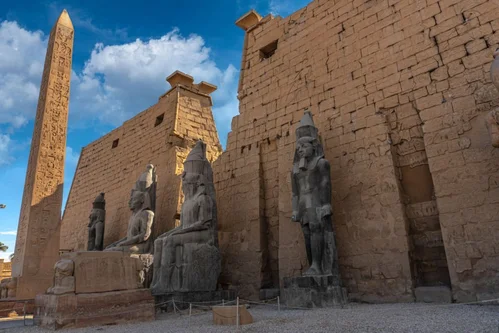
Early in the morning, a company-licensed tour guide will pick you up from your hotel and drive you by private air-conditioned vehicle to the West Bank of the Nile, where you will visit Medinat Habu, an archaeological site that is located opposite the modern city of Luxor, Egypt, on the West Bank of the River Nile close to the foot of the Theban Hills. Although there are additional buildings in the vicinity, the Mortuary Temple of Ramesses III is the location’s most well-known landmark today. The 150-meter-long temple is of orthodox design and closely recalls Ramesses II’s mortuary temple (the Ramesseum). It is enclosed by a sizable mud brick enclosure that may have served as a fortification and is remarkably well maintained. The original entrance is through a middle, a fortified gatehouse that resembles an Asian stronghold. Jean-François Champollion, who visited the ruins in 1829 and first recognized the hieroglyphs making up Ramesses’ names and titles on the walls, came up with the name, at least in its French form, Rhamesséion.Its original name was Thebes-the-city which connects with the House of millions of years of Usermaatra-steepen under Amon’s realm. You will be able to tour additional temples within the Habu Temple, such as the 18th Dynasty Temple of Amun which was constructed by Queen Hatshepsut and Thutmose III. It has undergone many alterations and modifications over the years, partially in the 20th, 25th, 26th, 29th, and 30th Dynasties and the Greco-Roman period.
Continue your day tour to Deir el-Medina, also known as The Valley of the Worker. During the 18th to 20th dynasties of the New Kingdom period (about 1550–1080 BC), Deir el-Medina was a community in ancient Egypt where the craftsmen who worked on the tombs in the Valley of the Kings lived. The paintings seem to be so new.
Visit Valley of the Queens to cap off your day of sightseeing. it is a location where the women of Pharaohs were interred in antiquity. Because many princes and princesses were interred there with various nobility members, it was referred to in antiquity as Ta-Set-Neferu, or “the place of the Children of the Pharaoh,” along with the queens of the 18th, 19th, and 20th dynasties (1550–1070 BCE). Mortuary priests looked after the tombs of these people, performing daily rituals and offering prayers and offerings to the dead nobility. On the west bank of the Nile, across from Thebes (modern Luxor), the valley is situated next to the more well-known Valley of the Kings. Due to its relative remoteness and closeness to the capital, this desolate region in the western highlands was chosen. The 18th dynasty monarchs decided to be buried in rock-cut tombs to preserve it as much as they could from tomb robbers rather than construct pyramids as conventional burial chambers (perhaps due to their vulnerability to tomb thieves).
Lunch at one of our local restaurants and transfer back to your hotel.
Afternoon excursion to the Mummification Museum and the Luxor Museum
The Luxor Museum, which is situated in a very lovely location on the east bank of the Nile between Luxor Temple and Karnak Temple, will be the first museum you visit. Our tour guide will pick you up in an air-conditioned car to visit Luxor’s two outstanding museums. The Museum exhibits a wide variety of artifacts, including “Jewellery, Furniture, Statues, Stelae, and Pottery” from the Theban Temples and necropolis, particularly from the new kingdom.
Continue your exploration of ancient Egyptian history by visiting the Mummification Museum, which was established in 1997 and is situated on the east bank. The museum exhibits human and animal mummies as well as the tools and techniques that were employed in the mummification process. there are also examples of the kinds of artifacts that we might find there.
After finish your tour, you will transfer back to your hotel & overnight Luxor.
Meals Included
Breakfast
Lunch
![Simba 2 [Recovered]-01](https://hakunamatataegypttours.com/wp-content/uploads/2019/02/Simba-2-Recovered-01-scaled.png "Simba 2 [Recovered]-01")